Bearded Dragon Enclosure Requirements
Choosing the right-sized terrarium for your bearded dragon is important and requires careful consideration. Your bearded dragon will spend most of their life in the terrarium, which is why it has a significant impact on their health, behavior, and overall well-being.
They rely on the terrarium for shelter, thermoregulation, enrichment, eating, and sleeping. If the terrarium is the wrong size, they will struggle to do the behaviors that keep them happy and healthy.
This article will cover the different terrarium size requirements for bearded dragons so that you can choose the perfect home for them.
Bearded Dragon Growth Stages and Size
Hatchling
Newly hatched bearded dragons are tiny, only measuring about 3 inches long. They grow rapidly within the first few months and are considered hatchlings up until they are 8 inches long. Most hatchlings are already this size by the time they are three months old and enter the juvenile stage.
Juvenile
Bearded dragons between 8 to 14 inches long are considered juveniles. They experience the most dramatic growth rate up until 10 to 12 months old, about the time they should be fully grown. Juvenile bearded dragons should have a similar sized terrarium to adults and will have outgrown the one they lived in as hatchlings.
Adult
Most adult bearded dragons measure between 14 to 24 inches in length, which can vary depending on their subspecies. The pygmy bearded dragon is the smallest subspecies, generally only growing up to 12 inches long. Central bearded dragons are the most common and largest subspecies kept as pets, growing up to 24 inches in length.
Minimum Terrarium Size Requirements
Here’s an overview of the minimum terrarium size requirements for each growth stage:
- Hatchling: 20 Gallons (24 × 12 × 16 inches)
- Juvenile: 75 Gallons (48 × 18 × 21 inches)
- Adult: 120 Gallons (48 × 24 × 24 inches)
Although you can house hatchlings and juvenile bearded dragons in small terrariums, we recommend starting with an adult-sized terrarium instead. Hatchlings can quickly outgrow a small terrarium, so it must be upgraded every few months. This is not only expensive but also stressful for bearded dragons who need to adjust to different enclosures each time.
The smallest recommended terrarium size for a hatchling is 20 gallons, with 40 gallons being ideal. If you prefer to house your hatchling in a terrarium under 40 gallons in size, it should be upgraded once they are three months old.
According to experts at UC Davis Veterinary Medicine, a single adult bearded dragon does well in a 120-gallon enclosure. However, this size works well for any growth stage.
You ideally want to house your bearded dragon in the largest terrarium you have the space for rather than one that is the minimum recommended size. Bearded dragons are active reptiles that love to explore, and a small enclosure can be stressful. Stress can make your bearded dragon more susceptible to certain health and behavioral issues, like stunted growth or tail biting.
Why Bigger is Better: Benefits of Larger Terrariums
The bigger the terrarium, the better it is for your bearded dragon. There are numerous benefits to housing your bearded dragon in a spacious enclosure. It promotes exercise, mental stimulation, and natural behaviors like exploring and basking.
In the wild, bearded dragons travel far distances in search of food and a comfortable basking spot. They cannot display these natural behaviors in a small enclosure, which is stressful.
Furthermore, a larger terrarium provides ample room for growth and proper thermoregulation. Bearded dragons are ectothermic reptiles that rely on external heat to control their internal body temperature. They cannot thermoregulate properly in a small environment by moving between the basking spot to the cooler area. Small terrariums heat up quickly, which can be fatal.
Larger terrariums also have plenty of space for enrichment items to keep your bearded dragon happy and stimulated. It’s difficult to fit all the supplies your bearded dragons need in a small terrarium without making them feel cramped.
Custom vs. Pre-made Terrariums
You have two main options for acquiring your bearded dragon’s terrarium—custom-built or pre-made.
Custom-made Terrariums
| Pros: | Cons: |
| Customized to meet your bearded dragon’s specific housing requirements. | Materials can be expensive. |
| More control over the terrarium’s aesthetics and design. | Customized to meet your bearded dragon’s specific housing requirements. |
| Unlimited sizes to choose from. | Custom orders usually take longer to build. |
If you want more control over the design, size, and aesthetics of your bearded dragon’s terrarium, consider having it custom-made. It can be customized according to your specific size requirements, whereas pre-made terrariums have limited size options. Features like built-in platforms or rock formations can be included to enhance your bearded dragon’s quality of life.
You can either make the terrarium yourself or pay a professional to do it for you. Keep in mind that custom-made terrariums can be pricey, considering you must buy all the materials yourself.
Pre-made Terrariums
| Pros: | Cons: |
| Easily accessible at most reptile stores and online retailers. | Limited control over the design and aesthetics. |
| Cost-effective option. | May contain harmful materials like exposed screws or toxic glue. |
| Occasionally sold as a starter kit with essential supplies. | Limited size options. |
Pre-made terrariums are a good option if you want a simple yet comfortable home for your bearded dragon. The main downside to these terrariums is the limited control over the design, size, and aesthetics. However, they tend to be the more cost-effective and easily accessible option.
You can easily find pre-made terrariums at most reptile stores or online retailers. Unlike custom-made terrariums, you don’t have to wait for it to be built and delivered, which can sometimes take weeks.
Setting Up the Perfect Terrarium
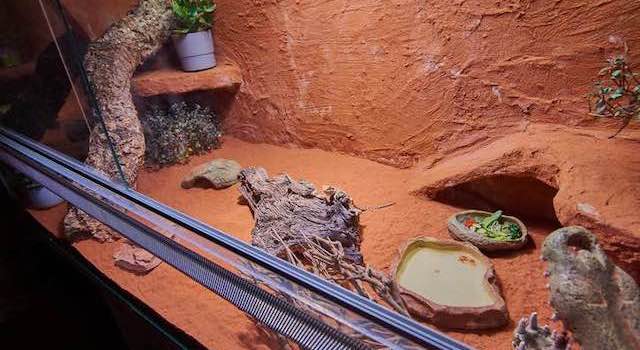
It’s important to set up your bearded dragon’s terrarium with the appropriate substrate, enrichment, and lighting equipment. The ideal terrarium setup should replicate their wild habitat and encourage natural behaviors, which will be discussed more in-depth below.
Heating and Lighting
In the wild, bearded dragons bask in the sun for warmth and essential UVB radiation. This isn’t possible in captivity, so artificial basking and UVB lights should be used to replicate these conditions.
Correct amounts of UVB light are needed to prevent metabolic bone disease, even if their diet contains Vitamin D3. Bearded dragons need warmth to digest their food properly and to stay active.
One side of the terrarium should have a basking light for warmth and the other a cooler side to create an ideal temperature gradient for thermoregulation. The air temperature gradient in the tank should range from 72-99°F (22-37°C). Experts at VCA Animal Hospital recommend placing the basking light on the outside of the enclosure to prevent accidental burns.
A T5 UVB Tube in a reflector fixture should be mounted at the same end of the tank as the basking globe. The T5 tube should cover half the tank’s length, with the tube’s center overlapping the basking globe. See our lighting guide here.
Substrate
The terrarium should be lined with a safe, absorbent substrate to keep your bearded dragon healthy. There are various substrates to choose from, but not all are safe.
Using the wrong substrate can lead to health issues like impaction, mold growth, or scale rot. Avoid using substrates like gravel, walnut shells, corn cob, cat litter, and calcium sand. These substrates put your bearded dragon at risk of impaction, especially if it’s used where they eat.
Some safer natural alternatives include desert sand, blends of soil and sand, and dried-out children’s play sand. You can use more than one type of substrate in the terrarium, like placing a tile near the feeding area and using a sandy substrate to cover the rest.
Enrichment
Enrichment is important for bearded dragons because it prevents boredom and promotes mental stimulation. The terrarium should have at least three different enrichment items that encourage natural behaviors, like digging, climbing, and basking.
Here are some enrichment ideas:
- Reptile-safe branches and stones for climbing.
- Two hides on either side of the terrarium for shelter.
- Live, safe plants to create a stimulating environment.
- Reptile hammocks for lounging.
- Platforms for exploring and climbing.
Avoid making the terrarium cluttered with more enrichment than necessary. This limits the amount of space your bearded dragon needs to move comfortably. Try arranging the décor throughout the terrarium to maximize the space.
Cleaning and Maintenance
Your bearded dragon’s enclosure must be cleaned on a regular basis. A dirty environment is harmful for these reptiles and puts them at risk of health problems like bacterial infections or respiratory issues. Larger enclosures are easy to maintain with daily spot cleaning. Unless your bearded dragon is particularly messy, you only need to deep clean their terrarium once a month.
Spot cleaning involves removing uneaten food, wiping soiled surfaces, and cleaning their food dishes. Sanitizing the glass and surfaces, replacing soiled substrate, and washing the décor is part of the monthly deep clean.
Common Mistakes in Choosing Terrarium Size
Here are four common mistakes to avoid when choosing the terrarium size:
Incorrect Size
You don’t want to make the mistake of purchasing an enclosure that is too small. It’s better to buy the correct size from the start for both the health of your bearded dragon and to avoid spending unnecessary money on an upgrade. Even hatchlings and juveniles can be housed in an adult-sized enclosure, which should ideally be 120 gallons in size.
Inadequate Ventilation
Terrariums should have plenty of ventilation so that bearded dragons have fresh air. Most pre-made enclosures include a secure mesh lid with plenty of ventilation. Some enclosures also have air holes on the side panels for cross ventilation, which encourages proper air circulation.
Accessibility Issues
Another common mistake is buying a terrarium that is difficult to access, usually because the doors are too small or in an awkward position. You need to regularly access the enclosure for maintenance and to feed your bearded dragon. Make sure that the terrarium can be easily accessed from at least two different openings.
Overcrowding
Lastly, you want to avoid overcrowding the enclosure with cluttered décor or cohabiting with bearded dragons. Bearded dragons don’t like clutter and enjoy having ample space to move freely. Also, cohabiting bearded dragons is discouraged because they are territorial and appreciate having lots of space to themselves.
Conclusion
Bearded dragons require spacious terrariums set up with appropriate substrates, enrichment, and lighting. A minimum 120-gallon terrarium is recommended for bearded dragons at any growth stage, whether a small hatchling or fully grown adult.
If your bearded dragon is currently housed in a terrarium below the minimum recommended size requirements, you should plan to upgrade it. Although you might feel your bearded dragon is perfectly okay in a small terrarium, the limited space interferes with their natural behaviors and leads to stress.
Remember, the bigger the terrarium, the happier and healthier your bearded dragon will be.