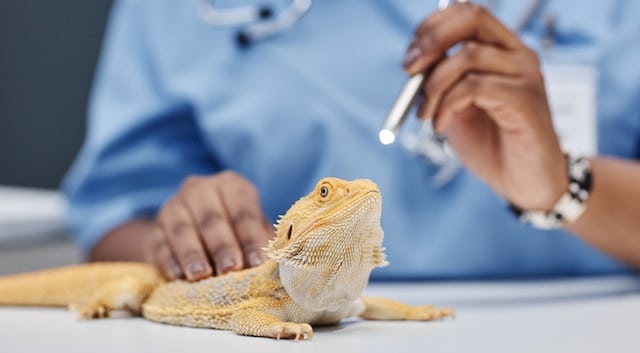

Impaction is one of the conditions that worries bearded dragon owners the most — and one of the most misunderstood. Walk into any pet shop or scroll through any keeping forum and you’ll hear the same warning: “don’t use sand, it causes impaction.” But that’s not the full picture, and the modern, evidence-based view of impaction is genuinely different from the advice that’s been passed around for the last 20 years.
The truth is, impaction is almost always a secondary condition — a symptom of something else going wrong with husbandry, diet, or health. Healthy bearded dragons with correct lighting, temperatures, and care rarely impact, even when kept on natural substrates that closely match the sand and soil they evolved on in the Australian outback.
This guide walks you through what impaction actually is, the warning signs to watch for, what really causes it (and what doesn’t), how to prevent it, and what to do if you suspect your dragon is impacted.
What Is Impaction in Bearded Dragons?
Impaction is a blockage in the bearded dragon’s digestive tract — usually somewhere between the stomach and the cloaca — that stops food and waste from passing through normally. The blockage can be caused by undigested food, indigestible material the dragon has swallowed, or a slow-moving mass that builds up over time when digestion isn’t working properly.
Without treatment, impaction can become serious quickly. The blockage puts pressure on internal organs, can interfere with circulation in the back legs, and in severe cases requires emergency veterinary surgery. The good news is that with proper husbandry it’s largely preventable, and when caught early it’s often treatable at home with vet guidance.
It’s also worth knowing that mild constipation isn’t the same as impaction. A bearded dragon that hasn’t pooped for a few days, especially during cooler weather or pre-brumation, may simply be slowing down — not impacted. Knowing the difference matters.
Signs and Symptoms of Impaction
Catching impaction early dramatically improves the outcome. Watch for the following:
- Not pooping for an extended period — longer than is normal for your individual dragon. An adult might normally go every few days to once a week, but if they’re well past their usual cycle and showing other symptoms, take note.
- Loss of appetite — refusing food they’d normally eat, often combined with general low energy.
- Lethargy and reduced activity — sleeping more, moving less, less interest in basking or surroundings.
- A visibly distended or swollen belly — especially if it feels firm to gentle touch.
- Straining without producing anything — visible pushing or repeated trips to a preferred bathroom spot with no result.
- Weakness or partial paralysis in the back legs — a more serious sign, indicating the blockage is pressing on the spinal nerves. This is a vet emergency.
- A small lump or mass you can feel through the belly wall — sometimes felt with gentle palpation along the spine.
- Vomiting or regurgitation — a sign the digestive tract is genuinely blocked. Always a vet visit.
One or two mild signs on their own can mean a lot of things — a dragon going into brumation, for example, will eat less and poop less. But a combination of signs, especially with a swollen belly or back-leg weakness, warrants attention.
What Actually Causes Impaction
Impaction has a few root causes, and the substrate alone is rarely the culprit. The real underlying drivers are almost always something else going wrong with husbandry or health.
Incorrect Temperatures and Lighting
This is the single biggest cause. Bearded dragons need a basking surface temperature of 108°F (42°C) to bring their core body temperature up to roughly 97.3°F (36.3°C) — the temperature they need to actually digest food. If basking temps are too low, food sits in the stomach undigested, ferments, and creates the conditions for impaction. Almost every impaction case traces back to a husbandry shortfall here in some way. See our ultimate bearded dragon lighting guide for the full breakdown of correct temperatures.
Food That’s Too Large or Too Hard
Surprisingly, the most common impactions seen in reptile veterinary practice aren’t sand impactions — they’re food impactions. Hard vegetables cut into chunks that are too big to digest properly (carrot, pumpkin, sweet potato) are repeat offenders. The rule of thumb is that no piece of food should be larger than the space between your dragon’s eyes. For harder vegetables, grate them or use a potato peeler to give thin strips instead of cubes.
The same size rule applies to live insects — never feed a bug whose body width is larger than the space between your dragon’s eyes.
Dehydration
A dehydrated digestive tract doesn’t move things along the way it should. Most bearded dragons get the bulk of their hydration from misted salads and gut-loaded insects rather than the water bowl, so if you’ve been skipping the misting or letting the salads dry out, hydration drops and slow digestion can follow.
Indigestible Substrate (the Real Ones)
Some substrates genuinely do cause impaction risk if ingested. These include:
- Bark chips and wood chips — too large, swell when wet
- Crushed walnut shells — sharp and indigestible
- Calci-sand — clumps in the gut when it gets wet
- Kitty litter — expands when it absorbs moisture
- Gravel — too large to pass safely
These belong nowhere near a bearded dragon enclosure, and there’s no “healthy dragon” exception.
Underlying Illness
Parasites, internal infections, spinal injuries, tumors, follicular or egg issues in females, and other primary illnesses can all slow or stop normal digestion. If your husbandry is solid and your dragon is still showing impaction signs, a vet visit is the right next step to rule these out.
Lack of Movement
Sedentary dragons in undersized enclosures with nothing to climb or explore have slower digestion than active dragons with proper space and enrichment. Movement helps the gut move things along. This is one more argument for a properly sized enclosure with plenty of climbing opportunities. LafeberVet’s clinical guide lists the same husbandry-first causes most reptile vets see in clinic.
The Sand Question: Does Natural Substrate Cause Impaction?
This is the big myth worth addressing directly. The “no sand” rule was built on a kernel of truth — bad substrates like calci-sand absolutely do cause impaction — but it got generalized into a blanket prohibition that doesn’t hold up against the evidence.
Wild bearded dragons live on sand. The field research of Dr Jonathan Howard (BeardieVet) measured the natural substrate composition where wild central bearded dragons (Pogona vitticeps) actually live, and found it’s roughly 95.9% sand, 2.3% clay, 1.5% silt, and 0.3% gravel. These animals evolved on sand. Their sticky tongues, their digestive system, their entire physiology is built around that environment.
In a captive setup with correct lighting, temperatures, and husbandry, a healthy bearded dragon on washed play sand, a sand/soil blend, or a bioactive substrate is not at meaningful risk of impaction. Their tongue is sticky enough that even when feeding on sand, they only ingest tiny residual amounts on the surface of the insect, and at proper digestive temperatures that material passes through their system without issue.
Where natural substrate does become a problem is when the underlying husbandry is wrong — basking temps too low, dragon already sick, dehydrated, or on parasite treatment. In those cases, impaction can occur, but the substrate isn’t the cause — it’s the husbandry. Fix the husbandry and the substrate is fine. We cover this in detail in our setting up a bearded dragon tank guide.
That said, for new arrivals, recently rescued dragons, dragons on parasite treatment, or those recovering from surgery — keep them on paper towel during that period. Once they have a clean bill of health, natural substrate is the way to go.
How to Prevent Impaction
Prevention comes down to getting husbandry right and being mindful at feeding time. The major levers:
- Correct basking temperature — 108°F (42°C) on the basking surface, verified with an infrared temp gun. This is the single most important factor.
- Proper UVB — a long T5 HO tube replaced on schedule, so your dragon’s calcium and vitamin D pathway is working properly.
- Food sized correctly — nothing larger than the space between your dragon’s eyes. Grate hard vegetables instead of cubing them.
- Allow proper digestion time — lights on for at least an hour before feeding, and at least two hours of lights after the last meal of the day.
- Stay hydrated — mist salads, gut-load insects with hydrating vegetables, offer fresh water daily.
- Skip dangerous substrates — bark chips, walnut shells, calci-sand, kitty litter, gravel.
- Provide space and enrichment — a properly sized enclosure with climbing branches, basking platforms, and varied terrain keeps your dragon moving.
- Don’t overfeed — stick to age-appropriate portions and frequencies. Power-feeding doesn’t help and adds pressure on the digestive system.
- Annual vet wellness checks — including a fecal sample to catch parasites early before they cause problems.
Get these right and impaction stops being a realistic worry for a healthy dragon.
What to Do If You Suspect Impaction
If your dragon is showing mild symptoms — slowed pooping, reduced appetite, mild lethargy — and they’re otherwise alert, eating a little, and not showing severe signs, there are a few things you can try at home alongside contacting your reptile vet for advice. None of this replaces a vet visit.
Warm Water Soak
A warm shallow soak is often the gentlest first intervention. Fill a tub with warm water — comfortably warm to your wrist, around 95-100°F (35-38°C) — deep enough to cover the dragon’s vent but not their head. Soak for 15-20 minutes. The warmth relaxes the gut, and the water can stimulate a bowel movement.
If your dragon drinks during the soak, don’t move them suddenly — they can aspirate water. Let them finish, lift them gently, and return them to the enclosure to warm back up under the basking spot.
Gentle Belly Massage
During or after the soak, you can very gently stroke the belly from front to back with a fingertip. The pressure should be barely there — this is encouragement, not manipulation. Never push hard or massage aggressively. If you’re not confident with this step, skip it and let the warm soak do its work alone.
Check Your Husbandry
While you’re managing the immediate symptoms, audit the basics. Is the basking surface actually hitting 108°F (42°C)? When did you last replace the UVB tube? Are temperatures dropping properly at night? Is the dragon getting enough open space and enrichment? Mild impaction is often a wake-up call that something in the setup has drifted.
When to See the Vet — and When It’s an Emergency
Some impaction signs always warrant a vet visit, and a few warrant an emergency one. Don’t delay on these:
- Hind leg weakness or paralysis — emergency. A blockage pressing on the spinal nerves needs immediate veterinary attention.
- Vomiting or regurgitation — emergency. Indicates a genuine blockage.
- Severely distended, firm belly — vet visit ASAP.
- Blood in the urate or stool — vet visit ASAP.
- Mild symptoms not improving after 2-3 days of warm soaks and husbandry corrections.
- Any combination of lethargy, refusal to eat, and constipation beyond a few days.
A reptile-experienced vet will typically start with a physical exam and may take X-rays to locate the blockage. Treatment options range from supportive care (fluids, gentle enemas, dietary modifications) right through to surgery for severe cases. The earlier you go in, the more likely the gentler options will work.
If you don’t already have a reptile vet, find one before you need one. Not every general vet sees reptiles, and an emergency isn’t the time to start the search.
Preventing Future Episodes
If your dragon has had impaction once, take it as a signal to audit your husbandry top to bottom. Most repeat cases are caused by the underlying issue not being addressed. Run through this checklist:
- Measure the basking surface temperature with an IR gun — is it really at 108°F (42°C)?
- Check the UVB tube install date — older than 12 months (Arcadia) or 6 months (most others)? Replace it.
- Review the substrate — is it on the dangerous list? Switch to natural sand, sand/soil, or bioactive.
- Audit food sizing — are vegetables being grated or cut to the right size?
- Check feeding timing — at least an hour of lights before feeding, two hours of lights after?
- Confirm hydration — are salads being misted, and are insects being gut-loaded with hydrating veg?
- Schedule a vet wellness check including a fecal exam to rule out parasites.
- Make sure the enclosure is large enough for proper movement and exploration.
One impaction is a warning. Two is a pattern, and the husbandry definitely needs work.
Frequently Asked Questions
What causes bearded dragon impaction?
Almost always poor husbandry, not the substrate. Cool basking temperatures (below 104°F / 40°C), low humidity, dehydration, parasites, over-feeding, hard-cut veg like carrot or pumpkin, and lack of movement are the real drivers. A healthy dragon with correct husbandry passes natural substrate without issue. Bark chips, walnut shells, and large pebbles carry real impaction risk regardless of husbandry.
Does sand cause impaction in bearded dragons?
No — not in a healthy dragon with correct temperatures, hydration, and diet. Wild central bearded dragons live on roughly 96% sand by composition. Sand impaction in captivity is almost always a secondary symptom of husbandry that was already failing. Fix the underlying husbandry, and natural substrate is safe.
What are the signs of impaction in bearded dragons?
No appetite, no defecation for longer than the dragon’s normal window (adults can normally go up to a week), lethargy, paralysis or weakness in the back legs, and sometimes the start of a prolapse. If you see those signs, get to a reptile vet promptly — at-home soaks alone won’t fix a true impaction.
How is bearded dragon impaction treated?
Treatment depends on severity. Mild cases respond to warm soaks (15–20 minutes daily), gentle abdominal massage, and subcutaneous fluid therapy from a vet. Severe cases need an enema or surgery. Critically — fixing the underlying husbandry, temperatures, and diet is the only way to prevent it recurring.
Can hard vegetables cause impaction?
Yes — particularly carrot and pumpkin cut too large or in chunks. Always grate or shave hard veg with a potato peeler into thin strips a dragon can swallow without chewing problems. Most surgical impactions in clinic involve food, not substrate.
How do I prevent bearded dragon impaction?
Dial in the husbandry: basking surface at 108°F (42°C), good UVB, hydration through misted salads and gut-loaded bugs, annual fecal testing, age-appropriate feeding amounts, hard veg grated finely, and regular movement and exercise outside the tank. Get those right, and impaction stops being a real concern.
Keep Reading
- The Ultimate Bearded Dragon Lighting Guide — get basking temps and UVB right, the single biggest factor in preventing impaction
- How to Set Up a Bearded Dragon Tank — substrate choices and enclosure essentials
- Bearded Dragon Food and Nutrition — feeders, salads, portions, and feeding schedules
- Bearded Dragon Health and Disease — broader health concerns and warning signs
- BeardieVet (Dr Jonathan Howard) — the field research underpinning much of our husbandry advice
Join the My Pet Reptile community
If this guide helped clear up the impaction question, subscribe to our newsletter for new care guides, husbandry tips, and the occasional myth-bust delivered straight to your inbox. And come join our Facebook group — it’s a friendly place to ask questions about your own dragon’s health, share enclosure setups, and learn from other keepers who genuinely care about getting it right.
The information in this guide is general in nature and is not a substitute for advice from a qualified reptile veterinarian. If your bearded dragon is showing signs of impaction or any serious illness, please see a reptile-experienced vet promptly.