Temperature is the engine that drives almost every system in a bearded dragon’s body. Digestion, immune function, calcium absorption, growth, behavior — all of it depends on your dragon being able to reach the right body temperature when they need to. Get the temperatures right, and your dragon thrives. Get them wrong, and you’ll see the consequences in slow digestion, lethargy, illness, and a beardie that just isn’t acting like themselves.
The good news is that the target numbers aren’t a mystery. We have decades of veterinary science, plus three years of real-world field data from Dr Jonathan Howard’s BeardieVet research on wild central bearded dragons in the Australian outback. We know what these animals actually achieve thermally when they choose where to bask — and that gives us hard targets to aim for in captivity.
This guide walks you through every temperature that matters in your bearded dragon’s enclosure — the basking surface, the ambient gradient, the cool side, night temps, and how all of them work together. We’ll cover the exact numbers, why they matter, how to measure them properly, what to do if yours are off, and the seasonal adjustments that mimic the natural year-round cycle.
Why Temperature Matters So Much
Bearded dragons are ectothermic — meaning they can’t generate their own body heat the way mammals do. To run their body, they have to seek out warmth from the environment, sit in it until their core temperature hits the right zone, then move to cooler spots when they’ve had enough. This process is called thermoregulation, and it’s why every aspect of your enclosure design comes back to temperature.
The temperature your dragon is actively targeting is their preferred optimal body temperature (POBT). For central bearded dragons (Pogona vitticeps), that’s around 97°F (36.3°C). This figure was first published in Judith Badham’s 1971 PhD thesis at the University of Sydney, and Howard’s BeardieVet field research has since confirmed it across hundreds of wild dragons measured in the outback.
At POBT, your dragon can digest food properly, fight off infection, run their immune system, and behave like the active, curious animal they’re supposed to be. Below it, everything slows down — including digestion, which is where the cascade of problems usually starts.
The Target Temperatures at a Glance
Here are all the numbers you need to hit. We’ll break each one down in the sections that follow.
| Zone | Target Temperature | How to Measure |
|---|---|---|
| Basking surface | 108°F (42°C), range 104-113°F (40-45°C) | Infrared temp gun on the basking rock |
| Hot side ambient air | 90-99°F (32-37°C) | Digital probe at basking height, in air |
| Cool side ambient air | 72-81°F (22-27°C) | Digital probe at substrate level, cool end |
| Dragon’s core body (POBT) | ~97°F (36.3°C) | Infrared gun pointed at the dragon’s back while basking |
| Night ambient | 50-72°F (10-22°C) | Digital probe; lights off; no heat unless ambient drops below 50°F (10°C) |
These are the numbers we work toward across the whole site. They come from a combination of veterinary research and direct field measurement of wild dragons — not from convenience or tradition.
Basking Surface Temperature: The Most Important Number
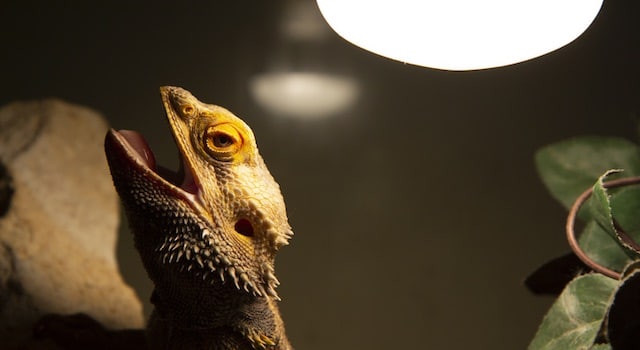
The basking surface is the spot directly under the basking globe where your dragon will sit to warm up. The target surface temperature is 108°F (42°C), with a workable range of 104-113°F (40-45°C).
Why this exact number? Because central bearded dragons need a basking surface significantly hotter than their target body temperature to get their core up to POBT. Wild dragons measured in the field consistently choose basking spots around 108-113°F (42-45°C) — and they’re choosing based on millions of years of evolutionary pressure to get the temperature right. We aim for the lower end of that range in captivity because the dragon has fewer options to escape if they overheat in a four-foot enclosure than they do in the open desert.
What Happens If It’s Too Low
Anything below 104°F (40°C) usually isn’t hot enough for an adult bearded dragon to reach POBT. The consequences:
- Food sits in the stomach undigested and starts to ferment
- Constipation, slow pooping, and a real risk of impaction
- Reduced immune function and increased susceptibility to illness
- Lethargy and reduced appetite
- Slower growth in juveniles
What Happens If It’s Too High
Anything above 113°F (45°C) starts to risk thermal burns and overheating. Wild dragons measured at higher temperatures — 122°F (50°C) and above — were almost exclusively on tarred roads (which absorb extreme heat) or males performing territorial displays. Neither situation reflects what a healthy adult dragon should be exposed to long-term in captivity.
How to Measure It Properly
Surface temperatures are measured with an infrared (IR) temperature gun, pointed directly at the basking platform. Don’t rely on the digital probe for this — probes measure air temperature, not the surface your dragon is actually lying on. A stick-on dial thermometer is essentially useless for the same reason.
Take readings after the lights have been on for at least an hour, with the dragon out of the way. Check at multiple times of day to confirm the thermostat is holding the temperature steady. If you’re consistently above or below 108°F (42°C), adjust by changing globe wattage or repositioning the basking platform a few centimeters closer or further from the bulb.
The Ambient Temperature Gradient
The basking surface temperature isn’t the whole story. Just as important is the ambient air temperature gradient across the enclosure — hot at one end, cool at the other, and a gentle slope in between. This is what lets your dragon thermoregulate: they sit on the basking spot until they’re warm enough, then move to cooler air to maintain that temperature without overheating.
- Hot side ambient (air, at basking height): 90-99°F (32-37°C)
- Cool side ambient (air, at substrate level): 72-81°F (22-27°C)
This gradient is one of the main reasons we recommend a minimum enclosure size of 4 × 2 × 2 feet (1200 × 600 × 600 mm). Anything smaller and you simply can’t establish enough thermal distance between the hot and cool ends — the whole enclosure becomes one warm zone with no real escape from the heat.
Measure ambient temperatures with digital probe thermometers, placed at the height your dragon will be using each area. Two probes work best — one on the hot side at basking height, one on the cool side at substrate level. Cheap stick-on dials are notoriously inaccurate and shouldn’t be your primary measurement.
Bearded Dragon Temperatures at Night
Night temperatures trip up a lot of new keepers, who hear “bearded dragons need heat” and assume that means heat 24 hours a day. The opposite is true: bearded dragons need a temperature drop at night. It’s how their circadian rhythm is supposed to work, and the drop actively boosts their immune function and encourages proper basking behavior the next morning.
The Right Night Temperature
An ambient temperature anywhere between 50°F (10°C) and 72°F (22°C) at night is completely fine for a healthy adult bearded dragon. They can comfortably handle the lower end of that range — it mimics a cool desert night, which is exactly what their bodies expect.
When You Need a Ceramic Heat Emitter
Supplemental night heat is only required if the ambient temperature inside the enclosure drops below 50°F (10°C). At that point, add a Ceramic Heat Emitter (CHE) — a device that produces heat with no visible light — on its own separate thermostat. Set the thermostat to bring night temperatures into the 68-75°F (20-24°C) range. Never higher than 75°F (24°C), because that defeats the purpose of having a night drop at all.
What you absolutely don’t want at night is any kind of light source — no red “moon” bulbs, no blue night bulbs, no infrared lamps that emit visible light. Bearded dragons can see color (this has been confirmed in modern research), and any light at night washes out their world and disrupts their sleep cycle. The same goes for using a CHE in the daytime — it doesn’t replace a basking globe and shouldn’t be running during light hours.
Seasonal Temperature Variation
In the wild, bearded dragons experience real seasonal changes — hotter summers with longer days, cooler winters with shorter days. Mimicking that cycle in captivity is good for their long-term health and supports normal behaviors like brumation.
- Summer: Lights on 12-14 hours a day, basking spot at the upper end of range (108-111°F (42-44°C)), cool side around 81°F (27°C).
- Winter: Lights on 8-10 hours a day, basking spot at the lower end of range (104-108°F (40-42°C)), cool side around 72°F (22°C). Night temperatures can drop lower than in summer.
Transition gradually between seasons over a couple of weeks rather than flipping a switch — a slow shift cues your dragon’s body to adjust naturally. If your dragon goes into brumation during the cooler months, that’s a normal, healthy response to the seasonal cue. We cover brumation in more detail in our health and disease section. Arcadia Reptile’s lighting and heat guide covers the same numbers and the underlying photobiology in depth.
How to Measure Bearded Dragon Temperatures Accurately
Getting accurate temperature readings is non-negotiable. You’ll need three things:
- Infrared temperature gun — for surface temperatures (basking platform, substrate, decor). Point and click, instant readout. Around $20-$50 USD for a reliable one.
- Two digital probe thermometers — for ambient air temperatures. One probe on the hot side at basking height, one on the cool side at substrate level. Combo thermometer/hygrometer units are ideal because they also track humidity. Around $15-$25 USD each.
- A dimming thermostat — controls your halogen basking globe automatically, dimming it as the surface temperature approaches your target. This is a safety device, not optional gear. $80-$200 USD depending on brand.
Avoid stick-on dial thermometers and cheap analog units. They’re often 9–18°F (5–10°C) off, which is the difference between “perfectly fine” and “your dragon can’t digest.” If you only buy one piece of gear, make it the IR temp gun — it instantly tells you whether the basking surface is doing its job.
Common Temperature Mistakes
A few things we see frequently enough to flag:
- Setting the basking spot to 97-100°F (36-38°C) because “that’s the dragon’s body temp.” The basking surface needs to be hotter than the dragon’s body to bring their core temperature up. Aim for 108°F (42°C) surface.
- Relying on ambient temperature alone. Air temperature doesn’t tell you whether your dragon can hit POBT — surface temperature does. Measure both.
- Using a heat mat or heat rock. These provide heat from below, which bearded dragons can’t register properly via their parietal eye. Burns are common because the dragon doesn’t move off in time. Heat must come from above.
- Running a coloured night bulb or any light at night. Disrupts circadian rhythm and serves no biological purpose. If you need night heat, use a ceramic heat emitter.
- Trusting weather-station air temperatures as captive targets. Wild dragons reach much higher body temperatures than the surrounding air by basking. Using “outside temperature” as your target dramatically under-heats your enclosure.
- Skipping the thermostat. Without one, basking globes can drift well above target on a warm day. A dimming thermostat is a safety device, full stop.
- Trying to maintain summer temperatures year-round. Seasonal variation is healthy. A consistent cooler winter is fine.
Troubleshooting Temperature Problems
If your temperatures aren’t hitting target, here’s where to look:
Basking surface too cool (under 104°F (40°C))
- Try a higher-wattage basking globe (jump from 75W to 100W, for example)
- Move the basking platform closer to the bulb — aim for 20-30 cm (8-12 inches) between the dragon and the globe
- Check the thermostat probe isn’t sitting in cool air or shaded from the heat
- Confirm the bulb is the right type — halogen floods produce far more usable heat than LEDs or spot bulbs
Basking surface too hot (over 113°F (45°C))
- Drop to a lower-wattage globe
- Move the basking platform further from the bulb
- Check your dimming thermostat is functioning and set to the right target
Cool side too warm (over 82°F (28°C))
- Check enclosure size — if it’s too small, there’s no real thermal escape from the basking zone
- Improve ventilation, particularly a vent low on the cool side
- Move the basking globe closer to the hot end to contain the heat plume
- If the room itself is too warm in summer, position the enclosure away from sunlight or use a fan in the room
Night temps not dropping enough
- Make sure all lights are completely off — including any CHE if your house isn’t actually cold enough to need one
- Improve room ventilation overnight
- If the room itself stays warm, the night drop will be modest — that’s okay as long as ambient stays under 75°F (24°C)
Bringing It All Together
Bearded dragon temperatures aren’t complicated once you know the targets. A 108°F (42°C) basking surface, a 72-99°F (22-37°C) ambient gradient across the enclosure, lights off at night with a drop into the 50-72°F (10-22°C) range, and seasonal variation throughout the year. Add an infrared temp gun, two digital probes, and a dimming thermostat, and you have everything you need to verify and maintain those numbers indefinitely.
The single biggest predictor of a long, healthy bearded dragon life is whether they can reliably reach POBT every day and cool off properly every night. Get those two things right, and you’ve handled the foundation of good husbandry.
Frequently Asked Questions
What temperature should a bearded dragon basking spot be?
The basking surface itself should sit at 104-108°F (40-42°C), measured with an infrared temp gun on the actual basking platform — not the air above it. That surface temperature lets the dragon reach its preferred optimum body temperature of around 97°F (36.3°C). Anything below 100°F (38°C) is too cool to digest food properly; anything above 113°F (45°C) carries burn risk.
What’s the right ambient temperature gradient for a bearded dragon?
Air temperature should run 90-99°F (32-37°C) on the hot side and 72-81°F (22-27°C) on the cool side, measured with a digital probe at basking height. That gradient is what makes thermoregulation possible — the dragon moves between zones to control body temperature. A 4 × 2 × 2 ft enclosure is the minimum size needed to actually create this gradient.
Do bearded dragons need heat at night?
Usually no. Bearded dragons need the temperature to drop at night — just as it does in the wild — to maintain a healthy circadian rhythm and boost the immune system. Lights off completely. Only run a ceramic heat emitter (no light) if the tank’s ambient air drops below 50°F (10°C), and only enough to bring it to 68-75°F (20-24°C). Never use a daytime heat source at night.
How do I measure bearded dragon temperatures accurately?
Two tools — an infrared temp gun for the basking surface (around $25-$50 USD) and a digital thermometer with probe for air temperatures (often combined with a hygrometer for $15-$25). Surface temp goes on the actual basking platform; ambient probes at basking level on the back wall, away from the lamp and basking spot. Stick-on analog dials are unreliable and shouldn’t be the primary measurement.
Why is my bearded dragon’s basking temperature too low?
Most common causes: too low a wattage for the tank size, the basking lamp too far from the platform, a thermostat probe placed in the basking zone (cycling the lamp off), or a hammock instead of a flat dense basking surface. A halogen flood at the right wattage on a dimming thermostat, 8-12 inches above a slate platform, is the standard fix.
Is a ceramic heat emitter or deep heat projector a good basking lamp?
No. Both produce heat without visible light, which means they can’t replicate the sun the way bearded dragons evolved to use it. Bearded dragons need a clear/white halogen flood globe for daytime basking. CHEs are night-only emergency heating for ambient temps below 50°F (10°C); DHPs aren’t recommended at all for daytime use.
Keep Reading
- The Ultimate Bearded Dragon Lighting Guide — the full deep dive on UVB, basking globes, fixtures, and the equipment to skip
- How to Set Up a Bearded Dragon Tank — the step-by-step build process including thermostat placement and gradient design
- Bearded Dragon Impaction — what happens when temperatures are too low for proper digestion
- Bearded Dragon Enclosure Ideas — design inspiration that supports proper temperature gradients
- BeardieVet (Dr Jonathan Howard) — the field research underpinning our temperature recommendations
Join the My Pet Reptile community
If this guide helped you dial in your enclosure temperatures, subscribe to our newsletter for new care guides, husbandry tips, and the occasional myth-bust delivered straight to your inbox. And come join our Facebook group — it’s a friendly place to share temperature readings, troubleshoot your setup with other keepers, and learn from a community that genuinely cares about getting it right.
The information in this guide is general in nature and is not a substitute for advice from a qualified reptile veterinarian.
Sign Up for Our Newsletter