Lighting is, without question, one of the most important parts of bearded dragon care. It’s not the bulbs themselves that matter most — it’s what proper lighting does for your dragon’s body. UVB allows them to absorb calcium and build strong bones. A good basking spot brings their core temperature up so they can digest food, fight off illness, and behave like the curious, active animals they were born to be.
A lot of the lighting advice you’ll come across — online, in older care books, even on the shelves of many pet shops — is years out of date. Coil bulbs, all-in-one globes, coloured night lamps, and heat mats are holdovers from an earlier era of reptile keeping, and they can quietly hold your dragon back. The good news is that the modern approach is actually simpler than the old one, well-supported by research, and easy to set up correctly the first time around.
This guide pulls together everything we’ve learned across more than a decade of keeping bearded dragons, alongside the field research of Dr Jonathan Howard (BeardieVet) and the lighting science of Dr Frances Baines MRCVS. Whether you’re setting up your first enclosure or refreshing an existing one, we’ll walk you through exactly what to buy, where to place it, the temperatures to aim for, and which equipment to leave on the shelf. Get this part right, and the rest of bearded dragon care becomes a whole lot easier.
Why Lighting Matters So Much for Bearded Dragons
Bearded dragons are diurnal, sun-loving reptiles native to Australia’s arid interior. Out there, they wake to a fierce sun, climb onto a high basking spot, and soak up hours of UVA, UVB, infrared heat, and bright visible light all at once. Every system in their body — digestion, calcium absorption, bone growth, immune response, hormonal cycles, reproduction — runs on that light.
In captivity, we have to recreate that light artificially. And we need two completely separate things to do it:
- UVB lighting — provides ultraviolet B radiation, which lets the dragon synthesize vitamin D3 and absorb dietary calcium. Without it, calcium can’t get into the bones, and metabolic bone disease (MBD) sets in.
- Basking heat — provides the intense overhead warmth needed to bring the dragon’s core body temperature up to its preferred optimal body temperature (POBT) of around 97.3°F (36.3°C). This is what lets digestion happen at all.
You cannot substitute one for the other. A basking globe doesn’t produce UVB. A UVB tube doesn’t produce real heat. You need both, mounted correctly, on a thermostat, replaced on schedule. Everything else in this guide builds on that.
UVB Lighting: What to Buy and Why
UVB is the part of bearded dragon care that breaks most often, because the wrong bulbs are still sold in pet shops and the right ones look more expensive at first glance. They’re not — they last longer, work better, and prevent vet bills that dwarf the price difference. Here’s what you actually need.
Use a Long T5 HO Tube, Not a Coil
When it comes to UVB, the modern standard is a long T5 HO tube — not a coil, not an all-in-one bulb, not a compact fluorescent. T5 HO (High Output) linear tubes spread strong UVB across a wide area, so your dragon can move around the enclosure and still receive useful exposure. Coil bulbs only emit usable UVB in a tiny zone directly underneath them, which means your beardie would need to sit in one exact spot to benefit — and that’s not how they naturally behave.
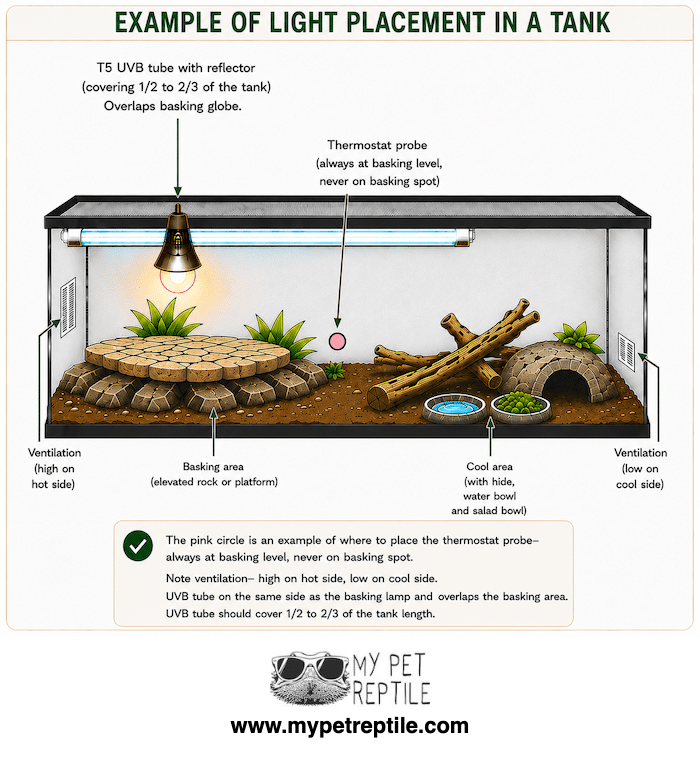
A T5 tube should cover roughly half the length of the enclosure, mounted on the hot side and overlapping the basking spot. It doesn’t need to span the full tank — you want a UV gradient just like a temperature gradient, so the dragon can move into and out of the strongest exposure.
Recommended Brands and Strengths
The two T5 HO tubes we recommend across the board:
- Arcadia ProT5 D3+ 12% or 14% — the gold standard. Lasts a full 12 months before output drops below useful levels. Pair it with the Arcadia reflector to push output downward instead of wasting half of it into the ceiling.
- Zoo Med Reptisun T5 HO 10.0 — a solid alternative. Generally needs replacing every 6 months, so factor that in.
Choose 12% for an open or mesh-topped tank where the bulb sits roughly 30-45 cm (12-18 inches) above the basking dragon. Step up to 14% if the bulb sits higher, or if you’re keeping a particularly large enclosure. Arcadia publishes detailed distance charts on their website — follow them.
Mounting and Distance
How you mount the T5 matters as much as which tube you buy. Two options work well:
- On top of a mesh screen lid — the easiest install, but mesh blocks roughly 30% of the UVB. Factor that into your choice of percentage.
- Inside the enclosure, suspended from the ceiling — better output reaching the dragon, no mesh blocking, but requires a secure mount the beardie can’t reach (they will absolutely try to climb on it and burn themselves).
The UVB tube should sit at the manufacturer’s “max irradiance” distance from the basking surface — typically 30-45 cm from the dragon’s back when basking. Too close and UV exposure is excessive. Too far and the dragon doesn’t get enough.
Replace Your UVB Tube on Schedule
UVB output drops well before a tube stops producing visible light. A dim-looking tube can already be useless from a UV perspective. Write the install date on the end cap with a marker, and replace on schedule:
- Arcadia ProT5: every 12 months
- Most other brands: every 6 months
Skipping replacement is one of the most common preventable causes of MBD in long-term-kept dragons. The bulb still glows, the dragon still basks, but the calcium pathway has quietly stopped working.
Basking Lights: The Heat Half of the Setup
Now for the heat. Bearded dragons can only digest food, move properly, and run their immune system when their core body temperature reaches roughly 97.3°F (36.3°C). That’s a finding from Dr Jonathan Howard’s three-year temperature study on wild central bearded dragons, and it matches the 1971 rectal-temperature data published in Judith Badham’s foundational PhD thesis on Pogona vitticeps. To get your captive beardie to that core temperature, the basking surface itself needs to be hot — significantly hotter than the air around it.
Use a Clear White Halogen Flood Globe
For the basking globe, you want a clear or white halogen flood-shape bulb. Not an “all-in-one” UVB-and-heat combo. Not a coloured globe. Not a spot bulb. Not LED. A halogen flood gives a wide, even pool of intense visible light plus the infrared-A wavelengths that actually penetrate the skin and warm the dragon from the inside, mimicking real sunlight far better than any other option on the market.
Arcadia’s Solar Basking range is the obvious pick. Any quality halogen flood will work — incandescent flood bulbs sold as “basking bulbs” are essentially halogens packaged for the reptile market.
Wattage by Tank Type
The right wattage depends on your enclosure material, size, and ambient room temperature. As a starting point:
- Glass tank (1200 × 600 × 600 mm): usually 100 W to start, dimmed via thermostat.
- Melamine or wooden enclosure (same size): usually 50-75 W — melamine retains heat much better, so you need less wattage to hit the same target temperature.
- Larger enclosures (1500 mm+): consider twin lower-wattage globes spaced over the basking zone rather than one massive bulb.
Always start higher than you think and let the thermostat dim it down to your target. Going too low means swapping bulbs.
Basking Distance: The 20-30 cm Rule
Position the basking platform (a flat rock, slate, or log) so that when the dragon is lying on it, their back sits roughly 20-30 cm (8-12 inches) from the globe. Closer than 20 cm risks thermal burns. Further than 30 cm and they often can’t reach the surface temperature they need to digest. Confirm the actual surface temperature with an infrared temp gun — distance is a starting point, not the final answer.
The basking platform itself should be flat and large enough for the entire dragon — head, body, and tail. A surface that only fits half the dragon leaves the rest in cooler air, defeating the purpose.
Target Temperatures and Why They Matter
Once everything is wired up and on a thermostat, you’re aiming for these numbers — verified with an infrared temp gun for surface temperatures and a digital probe thermometer for air temperatures:
| Zone | Target temperature | How to measure |
|---|---|---|
| Basking surface | 108°F (42°C) (range 104-113°F (40-45°C)) | Infrared temp gun on the basking rock |
| Hot side ambient air | 90-99°F (32-37°C) | Digital probe at basking level, in air, not on surface |
| Cool side ambient air | 72-81°F (22-27°C) | Digital probe at opposite end of enclosure |
| Dragon’s core body temp (POBT) | ~97.3°F (36.3°C) | Infrared temp gun pointed at the dragon’s back while basking |
| Night ambient | 50-72°F (10-22°C) |
These figures come directly from Howard’s BeardieVet field measurements of wild dragons in the Australian outback — they reflect what these animals actually achieve when they choose where to bask in nature.
If your basking surface is reading 100°F (38°C), that’s too low — your dragon won’t reach POBT, and food will sit in the stomach undigested. If it’s reading 122°F (50°C), that’s too hot — burn risk and overheating. Adjust wattage, distance, or both until you land in the 104-113°F (40-45°C) window.
Lighting Placement: How to Arrange Everything
Both lights go on the hot side of the enclosure, overlapping the basking platform. The dragon should be able to bask under heat and UVB at the same time, just as they would in the wild — the sun delivers both together, not one at a time.
- Mount the T5 UVB tube on the hot side, running roughly half the length of the tank.
- Position the halogen flood globe at one end of the UVB tube, so the basking platform sits in the overlap zone.
- In a 4 ft / 1200 mm enclosure, a single basking globe is usually enough. In a 5-6 ft enclosure, twin halogens spaced along the UVB zone give better coverage.
- The cool side stays empty of overhead lighting — that’s where the dragon goes to thermoregulate down.
Place the thermostat probe at basking-surface level — not on the cool side, not stuck to the glass. The probe needs to read what the dragon will experience.
Night Temperatures and CHE Use
Bearded dragons need a temperature drop at night. This isn’t optional — it’s how their circadian rhythm is supposed to work, and the drop actually boosts their immune function and encourages proper basking behavior the next morning.
The rule is simple: all lights off at night. No coloured “moon” bulbs, no red lamps, no blue night-time globes. They can see colour, the light disrupts their sleep cycle, and there’s no biological reason for it. A naturally cool, dark night is exactly what they need.
Only if the ambient air temperature inside the tank drops below 50°F (10°C) should you add supplemental night heat — and only via a Ceramic Heat Emitter (CHE), which produces heat with no visible light. Run the CHE on a thermostat, set to bring night temperatures into the 68-75°F (20-24°C) range. Never over 75°F (24°C) — that defeats the purpose of a night drop. Never use a CHE during the day, when you already have your basking globe doing the work.
Day Length and the Seasonal Cycle
Run lights on a timer to mimic the seasonal cycle:
- Summer: 12-14 hours on, 10-12 hours off.
- Winter: 8-10 hours on, 14-16 hours off.
Gradually transition between the two over a couple of weeks rather than flipping overnight. A natural seasonal shift cues the dragon’s body to adjust hormones, appetite, and brumation behavior the way it would in the wild.
If you want to take this further, smart lighting systems like the Arcadia LumenIZE range let you control multiple bulbs through an app, with sunrise and sunset dimming that ramps light up and down gradually rather than abruptly. It’s the closest the home market gets to a real day-night cycle.
Full-Spectrum LED Lighting
Full-spectrum LED bars are not a replacement for UVB or basking heat — but they’re a genuinely useful addition to a modern bearded dragon setup, and worth understanding properly. The idea is simple: standard incandescent and halogen basking globes produce light that’s heavily weighted toward the warm/red end of the spectrum. A full-spectrum LED fills in the rest — the blues, greens, and whites that give an enclosure that bright, mid-morning Australian sun look, rather than the dim amber glow of a single basking bulb.
The most popular option in the reptile hobby is the Arcadia Jungle Dawn LED bar. Originally designed to support plant growth in bioactive vivariums, the Jungle Dawn produces a broad, high-kelvin white light that’s also excellent for reptiles. Bright, natural-looking light stimulates normal daytime behavior — more activity, better color display, and more confident basking. Dragons kept under brighter, more complete light spectrums tend to look and act more like wild animals than those under dim single-globe setups.
What Full-Spectrum LED Does (and Doesn’t Do)
- Does: Provides bright, broad-spectrum visible light that improves the look and feel of the enclosure, stimulates natural activity, and supports live plant growth in bioactive setups.
- Does: Complements UVB and basking lighting — it fills in the visible spectrum that a single halogen doesn’t fully cover.
- Does not: Produce UVB. You still need a dedicated T5 HO tube for vitamin D3 synthesis.
- Does not: Replace the basking globe. It produces minimal heat and cannot bring a dragon to its preferred optimal body temperature.
Think of it as the third pillar of a complete lighting setup. UVB handles the biological side. The halogen handles the heat. The full-spectrum LED handles the visible light environment — the part that tells the dragon’s brain it’s midday in the Australian outback, not dusk in a spare bedroom. Run it on the same timer as the rest of your lights and size it to cover the full length of the enclosure for an even spread.
The Jungle Dawn comes in multiple sizes (24 cm, 46 cm, and 92 cm bars are the common options). For a 1200 mm / 4 ft enclosure, the 46 cm bar is a reasonable starting point; the 92 cm bar gives wall-to-wall coverage on larger builds. It’s particularly valuable if you’re running a bioactive setup — the plants genuinely need it, and your dragon benefits at the same time.
Equipment to Avoid
A few products are still commonly sold for bearded dragons but really don’t belong in a modern setup. These are the ones we’d recommend giving a miss, even if you spot them in pet shops:
- Coil UVB bulbs — UV output is tiny and only useful in a narrow zone directly underneath. Outdated.
- “All-in-one” mercury vapor or UVB-and-heat combo bulbs — you can’t independently control heat and UVB, and when one part fails (usually the UVB) you’ve still got heat so you don’t realize it.
- Coloured globes — red, blue, or “moonlight” bulbs — color-washes the enclosure (beardies can see color), disrupts circadian rhythm, no biological purpose. Older claims that they “can’t see red” have been disproven.
- Heat mats and heat rocks — bearded dragons don’t register heat well from below (the parietal eye on top of their head detects overhead heat), so they won’t move off a too-hot surface in time. Burns are common.
- Spot bulbs instead of floods — a tight spot beam creates a hot point too small for the whole dragon, with everything around it cooler.
- Pet shop “starter kits” — these typically include a coil UVB and an undersized heat globe. Buying the right gear from the start often works out cheaper than replacing things piece by piece later on.
Thermostats Are Mandatory
A thermostat isn’t optional gear — it’s a safety device. Without one, a basking globe can drift higher than its target temperature on a warm day, cooking the dragon below it. With one, the globe gets dimmed automatically as the temperature climbs.
One thing that trips up a lot of new keepers: a thermostat probe measures air temperature, not surface temperature. That means you don’t simply dial in 108°F (42°C) on the thermostat and call it done. Instead, you set the thermostat to an air temperature, then use your infrared temp gun to check what the basking surface is actually reading. Adjust the thermostat up or down until the gun confirms the surface is landing in the 104–113°F (40–45°C) range, then note that air-temp dial position — that’s your set point. Every enclosure is different, so there’s no shortcut around this step.
For the most accurate and safe readings, secure your thermostat probe to the back wall of the enclosure, roughly 2–3 inches (5–7 cm) off to the side of the actual basking platform at basking height. Never place it directly on the basking spot where your dragon can lay on it and block the sensor.
For halogen flood basking globes, you specifically want a dimming thermostat (not an on/off pulse thermostat), because dimming preserves the light quality — pulse thermostats turn the bulb fully on and fully off, which destroys the natural-looking sun effect. Habistat, Microclimate, and Arcadia all make reliable dimming thermostats. Don’t skimp here. Arcadia Reptile’s ProT5 product page publishes the wattage and percentage table this guide is built on.
The CHE, if you use one, goes on its own separate thermostat — an on/off type is fine for ceramic heat emitters because they don’t emit light.
Quick Reference: Lighting Equipment Checklist
If you’re starting from scratch, here’s the complete shopping list for a 1200 × 600 × 600 mm enclosure:
- Arcadia ProT5 D3+ 12% or 14% UVB tube (size to cover half your tank length)
- Arcadia T5 reflector to match the tube
- Halogen flood basking globe (50-100 W depending on enclosure material)
- Ceramic basking lamp fixture rated for the wattage
- Dimming thermostat (Habistat, Microclimate, or Arcadia)
- Digital probe thermometer (two, ideally — one for hot side, one for cool side)
- Infrared temperature gun for measuring basking surface temps
- Programmable timer for the lights
- Optional: Ceramic Heat Emitter + on/off thermostat for cold nights only
- Optional but recommended: Arcadia Jungle Dawn LED bar for full-spectrum visible light — especially worthwhile in bioactive setups with live plants
Signs Your Lighting Setup Is Wrong
Your dragon will tell you if something’s off. Watch for these warning signs:
- Refusing to bask, or basking only briefly — could mean the surface is too hot, or the dragon is unwell. Recheck your temps with an IR gun.
- Sitting under the basking spot all day without moving — often means the basking surface isn’t hot enough to bring core temp up.
- Undigested food in the poop — classic sign that basking temps are too low for proper digestion.
- Soft or rubbery jaw, tremors, weakness in the legs, deformed spine — early signs of metabolic bone disease (MBD), almost always linked to a failed or expired UVB tube. Get to a reptile vet immediately and replace the tube.
- Pale color, lethargy, hiding constantly — could be temperature, lighting cycle, or something else. Recheck every setting and consult your vet if it persists.
Why We Trust the Research We Cite
Almost every number in this guide can be traced back to two people. Dr Jonathan Howard (BeardieVet) spent three years measuring the body, substrate, and air temperatures of wild central bearded dragons across the Australian outback — his data is the closest thing we have to direct evidence from the environment these animals evolved in. Dr Frances Baines MRCVS co-developed the Ferguson Zones system used to match UVB output to a species’ natural sun exposure, and her published work underpins every credible lighting recommendation in the modern hobby. Where their findings line up, we follow them. Where the older hobby wisdom conflicts with their data, we update.
Tying It All Together
Bearded dragon lighting really isn’t as complicated as it can first appear. You need a long T5 HO UVB tube covering half the tank, a clear halogen flood globe overlapping that UVB to create a 108°F (42°C) basking spot, a dimming thermostat keeping things safe, and a cool side around 72-81°F (22-27°C) for your dragon to retreat to. Lights on for around 12 hours in summer, 8-10 hours in winter. Nothing on at night unless your house drops below 50°F (10°C), in which case a CHE on its own thermostat handles it nicely. Replace tubes and bulbs on schedule, and you’re set.
Get this right, and you’ve sorted the single most important variable in your dragon’s life. The rest of good husbandry — diet, naturalistic substrate, enclosure size, enrichment — gets easier from here.
Frequently Asked Questions
What’s the best UVB bulb for a bearded dragon?
A T5 HO tube in a reflector — Arcadia ProT5 12% or 14% depending on mounting height and whether there’s mesh in the way. Coil UVB, compact fluorescents, and mercury vapor combos are all unsuitable. Size the tube to span roughly half the enclosure, positioned so the basking platform sits inside the UV zone.
How often should I change my bearded dragon’s UVB bulb?
Every 12 months for Arcadia T5 tubes; every 6 months for most other brands. UVB output drops well before the light visibly fails, and a dragon under a depleted bulb gets none of the benefit even though the tube looks fine. Note the change date on the bulb or in a calendar reminder.
What’s the best basking lamp for a bearded dragon?
A clear or white halogen flood globe — never a coloured globe, mercury vapor, or deep heat projector. Wattage depends on tank size and material: typically 75-100W in a 4 × 2 × 2 ft glass tank, lower in a PVC or wooden enclosure. The flood spread is important — spot globes create too narrow a basking zone.
Do bearded dragons need a red night light?
No — and red night lights are actively harmful. Bearded dragons can see red, and a red lamp color-washes the entire enclosure, disrupting circadian rhythm and causing chronic stress. The right approach is no light at night at all. If the room temperature drops below 50°F (10°C), use a ceramic heat emitter for warmth only — never a coloured lamp.
How far should the UVB tube be from a bearded dragon?
Distance depends on the tube strength. Check Arcadia’s published table for the ProT5 range: as a rough guide, the dragon’s back at the basking platform should sit roughly 12-15 inches (30-38 cm) below a 12% tube mounted inside the enclosure, or closer with a 14% tube mounted above mesh. Always check the manufacturer’s distance for the specific bulb.
Is a mercury vapor bulb okay for a bearded dragon?
No. Mercury vapor (“all-in-one”) globes combine heat and UVB in one bulb but can’t run on a dimming thermostat, and the UVB output is unreliable — sometimes well above safe levels. They’ve been superseded by separate T5 UVB tubes and halogen basking globes for good reason. Don’t use them on bearded dragons.
Keep Learning
If this guide has been useful, there’s plenty more in the same evidence-based vein on the rest of the site:
- The Bearded Dragon Beginner’s Guide — start here if your dragon is on its way home.
- Bearded Dragon Food and Nutrition — feeder bugs, salads, supplementation, and feeding schedules by age.
- Bearded Dragon Health and Disease — recognizing the early signs of MBD, respiratory infections, and other common issues.
- Arcadia ProT5 product line — official distance charts and specifications for the recommended UVB tubes.
Join the My Pet Reptile community
If you found this guide helpful, subscribe to our newsletter for new care guides, husbandry updates, and the occasional myth-bust delivered straight to your inbox. And come hang out in our Facebook group — it’s full of bearded dragon owners sharing enclosure setups, troubleshooting issues, and supporting each other toward better care. Drop in, ask questions, share your dragon. We’d love to have you.
The information in this guide is general in nature and is not a substitute for advice from a qualified reptile veterinarian. If your dragon is showing signs of illness, please see a vet.
Sign Up for Our Newsletter