If there’s one piece of bearded dragon gear people routinely buy too small, it’s the terrarium. Pet shops often sell undersized tanks marketed as “starter” or “baby” enclosures, and new keepers understandably assume a small dragon needs a small home. Both assumptions lead to the same expensive mistake.
The truth is simple: bearded dragons need a lot more space than most setups give them, and the right size isn’t really about the dragon’s body — it’s about the environment that size makes possible. A proper terrarium is what lets you build the temperature and UV gradients your dragon needs to thermoregulate and stay healthy.
This guide covers the minimum terrarium size, why bigger is always better, how gallon and foot measurements line up, why babies need a full-size tank too, and the common size questions keepers ask before buying.
The Minimum Bearded Dragon Terrarium Size
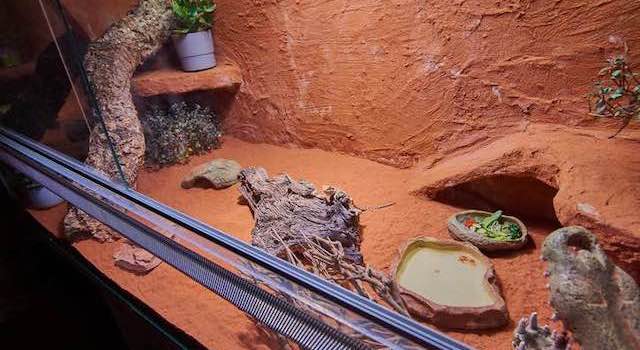
The absolute minimum size for an adult bearded dragon is 4 × 2 × 2 feet (1200 × 600 × 600 mm), which works out to roughly 120 gallons. That’s the floor, not the target — and we’d genuinely encourage you to go bigger if you have the room.
Anything smaller than this simply doesn’t give you enough physical space to create the conditions a bearded dragon needs. A 3-foot tank (or smaller) can’t accommodate a proper basking zone at one end and a genuinely cool retreat at the other — and without that, your dragon can’t thermoregulate the way their body is designed to.
Why Terrarium Size Matters So Much
While legacy resources like VCA Animal Hospitals suggest starting small and scaling up to 100+ gallons as the dragon grows, modern husbandry circles recommend skipping that middle step entirely — there’s nothing a smaller starter tank gives a baby that a properly designed full-size enclosure can’t.
Reasons a larger terrarium is essential
The reason for the minimum size isn’t arbitrary, and it isn’t just about giving your dragon room to walk around (though that matters too). It comes down to two gradients that a small tank physically can’t produce:
- The temperature gradient. Bearded dragons are ectothermic — they move between warm and cool areas to regulate their body temperature. You need a basking surface around 108°F (42°C) at one end and a cool side of 72-81°F (22-27°C) at the other. In a small tank, the whole space just becomes one warm zone with nowhere to cool down.
- The UV gradient. Your dragon needs to be able to move into and out of stronger UVB exposure, just as they would by moving in and out of sun in the wild. That gradient needs length to exist.
A correctly sized terrarium is what makes good husbandry physically possible. It’s the foundation everything else — lighting, temperatures, and enrichment — is built on.
How Big Do Bearded Dragons Get?
Part of the reason people undersize the tank is underestimating how big bearded dragons actually become. A full-grown adult typically reaches 45-60 cm (18-24 inches) from snout to tail tip — and crucially, they grow fast, usually reaching close to full size by around 12 months of age. The tiny hatchling you bring home will be a substantial lizard within a year.
An adult that size needs real floor space to move, climb, bask, and retreat — which is exactly why the 4 × 2 × 2 ft minimum exists.
Do Baby Bearded Dragons Need a Smaller Tank?
This is one of the most persistent myths in the hobby, and it costs keepers money. The idea that babies need a small tank — and that a big enclosure will “stress them out” or stop them finding food — doesn’t hold up.
Here’s the reality: a baby bearded dragon does perfectly well in a full-size enclosure. There’s nothing about a larger tank that’s harmful to them, and they grow so fast that any “baby tank” you buy will be outgrown within months. Buying a small enclosure first and a big one later means paying twice. Save your money and buy the 4 × 2 × 2 ft straight away.
The one practical tweak for babies is making sure they can find their food and aren’t overwhelmed — easily handled by feeding insects in a separate tub or one at a time, and keeping a clear basking area. That’s a feeding-management detail, not a reason to buy a small tank.
Terrarium Size Chart: Gallons, Feet, and Millimeters
Because tanks are sold by gallons in some places and by dimensions in others, here’s how the common sizes line up — and where each one fits (or doesn’t) for a bearded dragon:
| Size | Dimensions | Suitable for? |
|---|---|---|
| 20-40 gallon | up to ~3 ft long | Too small — temporary baby use at most, not an adult home |
| 120 gallon | 4 × 2 × 2 ft (1200 × 600 × 600 mm) | The minimum for an adult |
| ~150 gallon | 5 × 2 × 2 ft (1500 mm) | Better — more room to thermoregulate properly |
| ~180 gallon | 6 × 2 × 2 ft (1800 mm) | Excellent — ideal if you have the space |
Note that floor space (length × depth) matters more than height for a ground-dwelling lizard. A tall, narrow tank doesn’t give the same usable area as a long, wide one of the same volume.
The Pygmy (Rankins) Dragon Myth
Pygmy or Rankins bearded dragons (Pogona henrylawsoni) are a little smaller than their central bearded dragon cousins — but that does not mean they need a smaller tank. These little dragons are incredibly active, and they need the same bare minimum of 4 × 2 × 2 ft, for the same reason: the thermal layout and UV exposure zones require that length regardless of the dragon’s size. Bigger is better for them too. Please don’t keep Rankins dragons in tiny tanks — they deserve the same space as any other beardie.
Going Bigger Than the Minimum
If you can fit a larger enclosure, do it. A 5 ft or 6 ft terrarium gives your dragon:
- More room to roam, climb, and exhibit natural behaviors
- A more reliable hot-to-cool cycle, with a genuinely cool end
- More space for naturalistic decor, hides, and climbing features
- Easier management of bioactive setups, which benefit from the extra volume
There’s really no such thing as “too big” for a bearded dragon, as long as you can still maintain the correct temperatures and provide enough enrichment to fill the space. For inspiration on how to design a larger build, see our bearded dragon enclosure ideas.
Frequently Asked Questions
Is a 40 Gallon Tank Big Enough for a Bearded Dragon?
No — not for an adult. A 40 gallon tank is too small to create the proper temperature and UV gradients a bearded dragon needs. At most it’s a short-term option for a young baby, but since they grow so fast, you’re far better off buying the full-size 120 gallon (4 × 2 × 2 ft) enclosure from the start.
Is a 120 Gallon Tank Big Enough?
Yes — 120 gallons (4 × 2 × 2 ft) is the minimum recommended size for an adult bearded dragon, and it works well when set up correctly. If you have space for larger, even better, but 120 gallons is a solid, proper home.
What Size Tank Does a Baby Bearded Dragon Need?
The same as an adult — a full 4 × 2 × 2 ft. Babies grow to near-full size within a year, and a larger enclosure causes them no harm. Just manage feeding so a small dragon can easily find its food.
Does Height Matter for a Bearded Dragon Terrarium?
Floor space matters most, since bearded dragons are ground-dwellers, but some height is useful for adding climbing branches and basking platforms at varying levels. The standard 2 ft (600 mm) height works well — enough for vertical enrichment without wasting space.
Can Two Bearded Dragons Share a Terrarium?
No — bearded dragons are solitary and territorial in the wild. Cohabiting almost always ends in stress, fighting, missed feedings for the smaller dragon, and at worst, serious injuries. One dragon per enclosure, with separate setups if you keep more than one.
How Big Should a Bearded Dragon Tank Be in Liters?
Around 430-450 liters as a minimum, which matches the 120 gallon / 4 × 2 × 2 ft footprint. Don’t focus too hard on the volume number — the key is having at least 1200 mm (4 ft) of length so you can create the proper hot-to-cool gradient.
The Bottom Line
The right bearded dragon terrarium size is at least 4 × 2 × 2 feet (1200 × 600 × 600 mm, roughly 120 gallons) — for adults and babies alike, and for Rankins dragons too. Bigger is always better. The size isn’t about the dragon’s body so much as the environment it allows you to build: the hot-to-cool cycle and UV exposure range that keep your dragon healthy. Buy the big tank once, set it up properly, and you’ve laid the foundation for everything else.
Keep Reading
- How to Set Up a Bearded Dragon Tank — the full step-by-step build once you’ve got the right size
- Bearded Dragon Enclosure Ideas — design inspiration for your space
- The Ultimate Bearded Dragon Lighting Guide — the lighting your terrarium needs
- Bearded Dragon Temperatures — the gradient your tank size makes possible
- Beginner’s Guide — everything to get sorted before your dragon comes home
Join the My Pet Reptile community
Setting up a new enclosure? Subscribe to our newsletter for care guides, setup tips, and the occasional myth-bust delivered straight to your inbox. And share your build in our Facebook group — it’s a friendly place to get feedback on your terrarium from keepers who’ve been there.
The information in this guide is general in nature and is not a substitute for advice from a qualified reptile veterinarian.
Sign Up for Our Newsletter